Phone Charging Unstable — Power Input Fluctuation or Software Control Issue?
Quick Answer
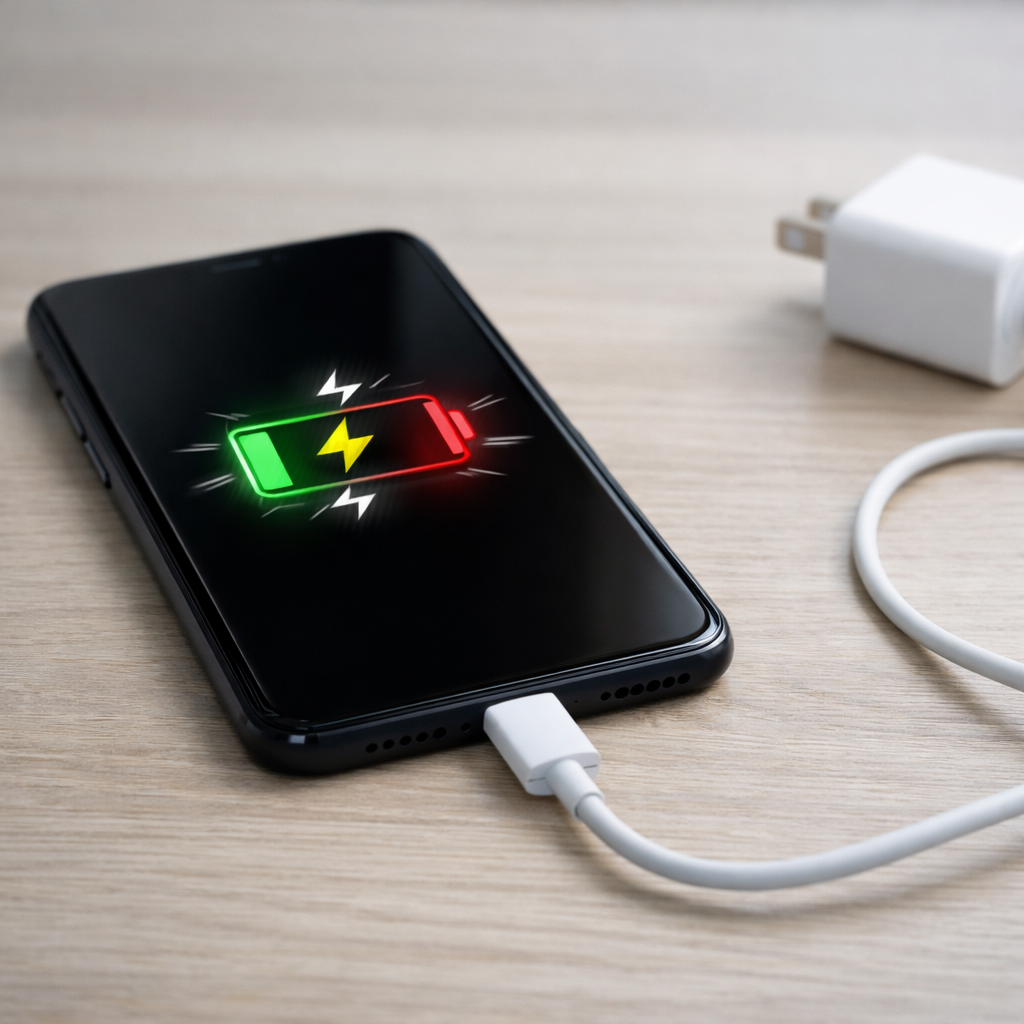
Unstable charging is most often caused by a fluctuating power source (cable, adapter, port, or outlet) or by software that is actively adjusting charging speed to protect the battery. Your phone may be rapidly switching between “charging” and “not charging,” or the battery percentage may stall, jump, or move in small bursts.
In many cases this is normal for short periods, especially when the phone is hot, you’re using it while charging, or the battery is near 80–100%. If the behavior happens on multiple chargers for several days, or it starts after a drop or water exposure, it’s more likely a connection or hardware issue.
If you need a fast fix
- Try a different known-good cable and wall charger (not a laptop port) and plug directly into a wall outlet.
- Clean the charging port gently by turning the phone off and removing lint with a wooden toothpick or soft brush.
- Restart the phone and turn off battery optimization features temporarily (like Optimized Charging or fast-charge toggles) to test stability.
Quick Diagnosis Table
| Symptom | Most likely cause |
|---|---|
| Charging icon flickers on and off when the cable is touched | Loose cable/port fit, debris in port, or worn connector |
| Charges normally on one charger but not another | Adapter/cable can’t provide stable power or is failing |
| Charging slows down or pauses around 80–100% | Software battery protection (optimized charging, heat control) |
| Battery percentage jumps or drops during charge | Battery gauge calibration drift or unstable power input |
| Charging stops when phone warms up (gaming, sun, thick case) | Thermal throttling: software limits charging to reduce heat |
Why This Happens
Your phone’s charger is not just “on or off.” The phone and charger negotiate how much power to send, and the phone constantly adjusts that power based on temperature, battery level, and system settings.
If the power coming in is unstable, even for a split second, the phone may reset the charging handshake and appear to stop and start charging. This can happen with a damaged cable, a tired wall adapter, lint in the port, or a loose outlet.
Software can also make charging look unstable on purpose. When the phone is hot, or when the battery is near full, the charging controller can reduce wattage, pause, then resume, which shows up as slow charging, brief drops to “not charging,” or uneven percentage movement.
Most Common Causes (Ranked)
- 1) Bad cable or loose connector: The most common cause is a cable that can’t hold a steady connection, especially at the plug ends. Even slight movement can cause rapid reconnects that look like “flickering” charging.
- 2) Debris or wear in the charging port: Pocket lint can prevent the plug from seating fully, and worn port pins can make contact unreliable. This often makes charging angle-dependent.
- 3) Weak, overheating, or low-quality wall adapter: Some adapters sag in voltage under load or overheat and throttle, causing the phone to repeatedly renegotiate charging. Off-brand “fast chargers” are frequent offenders.
- 4) Battery protection features or OS charging control: Optimized charging, adaptive charging, and thermal protection can slow or pause charging to extend battery life. This is especially noticeable from 80% to 100%.
- 5) Heat from usage or environment: Using navigation, gaming, hotspot, or charging in a hot car can push temperatures high enough that the phone limits charging. Thick cases can trap heat and worsen it.
- 6) Battery aging or internal hardware fault: An older battery can have higher resistance, leading to more heat and more aggressive throttling. Less commonly, a failing charging IC or damaged board causes persistent instability.
If stability improves after changing the cable/adapter or after the phone cools down, that gradual improvement usually means the issue is power quality or temperature control rather than a major internal failure.
How to Check the Problem Safely
- Check 1: Test with a different cable and wall adapter that you trust, ideally the original or a certified replacement. If the problem disappears, the old cable/adapter is the likely cause.
- Check 2: Try a different power source: a different wall outlet, and avoid power strips or loose extension cords. If charging becomes stable on another outlet, the outlet or strip may be the issue.
- Check 3: Inspect and clean the port: power the phone off, shine a light into the port, and remove lint carefully with a wooden toothpick or soft brush. If the plug clicks in more firmly afterward, you found the cause.
- Check 4: Check for heat control: remove the case, stop heavy apps, and charge with the screen off for 15–20 minutes. If it stabilizes while cooler, thermal throttling is involved.
- Check 5: Look for software patterns: note whether instability appears mainly above 80%, overnight, or only with fast charging enabled. That timing strongly points to software charging management.
Safety note: do not use metal tools in the charging port, and stop charging immediately if you smell burning, feel excessive heat, or see swelling.
How to Fix It
- Fix 1 (easiest): Swap to a known-good cable and charger and charge from a wall outlet. This removes the most common source of power fluctuations and instantly confirms whether accessories are to blame.
- Fix 2: Clean the port and ensure a firm connection. A fully seated plug reduces micro-disconnects that trigger repeated charging restarts.
- Fix 3: Reduce heat while charging by removing the case, avoiding gaming/video calls, and charging in a cool, shaded area. Lower temperatures stop the phone from throttling or pausing charging.
- Fix 4: Adjust charging settings for testing: disable optimized/adaptive charging for a day, or turn off fast charging if your phone allows it. A slower, steadier charge can eliminate instability caused by aggressive fast-charge negotiation.
- Fix 5 (advanced/last resort): Update the OS and perform a settings reset if the issue started after an update or a settings change. If instability persists across multiple verified chargers, arrange a port inspection or battery test because internal charging hardware may be failing.
Signs of Battery or Hardware Damage
- Phone gets unusually hot near the charging port or battery area even while idle.
- Charging only works at a specific angle, or the plug feels loose and won’t “click” into place.
- Battery percentage drops quickly after unplugging, or shuts down at 20–40%.
- Random restarts or the phone repeatedly disconnects/reconnects to power with multiple cables.
- Swollen back cover, screen lifting, or a rocking phone on a flat table.
- Burning smell, discoloration around the port, or visible corrosion (especially after water exposure).
- “Liquid detected” or repeated accessory warnings that never resolve after drying time.
When Repair Is No Longer Worth It
If the phone needs both a battery replacement and a charging port repair, the combined cost can approach the value of an older device. Repairs are usually worth it when the phone is relatively new, still receiving updates, and the screen and cameras are in good shape.
As a rule, if the repair quote is more than 40–50% of the cost of a comparable replacement phone, consider upgrading instead. If data reliability matters (work phone or travel), prioritize a device that charges consistently over squeezing a few more months out of unstable hardware.
How to Prevent This Problem in the Future
- Use a quality, certified cable and charger that matches your phone’s fast-charging standard.
- Avoid charging through loose power strips or worn outlets that can create brief power drops.
- Keep the charging port clean by limiting pocket lint exposure and checking the port monthly.
- Reduce heat during charging: remove thick cases, avoid direct sunlight, and don’t game while fast charging.
- Enable optimized charging for daily use, but understand it can slow or pause charging near full.
- Unplug by gripping the connector head, not the cable, to prevent internal wire breaks.
- If you use a car charger, pick a reputable model with stable output and avoid cheap multi-port adapters.
FAQ
Why does my phone say “charging” but the percentage doesn’t go up?
This often happens when the phone is using power as fast as it’s receiving it, like during gaming, hotspot use, navigation, or a bright screen. It can also happen near 80–100% when software slows charging to protect the battery. Test with the screen off and heavy apps closed to see if the percentage increases normally.
Is it normal for charging to slow down at 80% or stop at 100%?
Yes, many phones charge quickly up to around 50–80%, then slow down near full to reduce heat and battery stress. Some models pause at 80–90% and finish later based on your routine (optimized/adaptive charging). If it never completes to 100% on a known-good charger, check for heat or a failing cable/adapter.
Can a software update cause unstable charging?
It can, especially if the update changes battery protection behavior or introduces a bug that affects charging negotiation. First, rule out cables, adapters, and port debris, since those are more common. If the timing matches an update and hardware checks out, install the latest patch and consider a settings reset to clear conflicting power settings.
For a full overview of this issue and step-by-step solutions, read the complete troubleshooting guide.
Mark Reynolds explains battery and charging issues in a practical way, focusing on what actually helps in real situations. For more guidance, see the step-by-step troubleshooting guide.