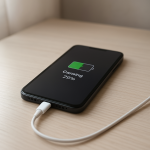
Phone Charging But Percentage Not Increasing — Power Consumption Higher Than Input
Quick Answer
If your phone says it’s charging but the battery percentage doesn’t go up, the most common reason is that the phone is using more power than the charger is providing. The phone is still receiving energy, but it’s being spent immediately on the screen, apps, heat, and background activity instead of filling the battery.
This often happens during heavy use (gaming, video calls, hotspot) or when using a weak charger/cable. It’s also common for the percentage to appear “stuck” for 5–20 minutes when the phone is hot, charging very slowly, or recalibrating its battery estimate.
If you need a fast fix
- Turn on Airplane Mode and lower screen brightness to reduce power use while charging.
- Switch to a known-good wall charger and cable (avoid laptop USB ports and cheap adapters).
- Lock the screen and let it charge untouched for 15–30 minutes in a cool place.
Quick Diagnosis Table
| Symptom | Most likely cause |
|---|---|
| Battery icon shows charging but percentage stays the same while you use the phone | Power draw (screen, apps, data, gaming) is higher than charger output |
| Percentage increases only when the screen is off | Charger is too weak or cable has high resistance, so charging can’t keep up with active use |
| Phone is warm/hot and percentage barely moves | Heat throttling slows charging to protect the battery |
| Charging is “slow” message or estimated time is extremely long | Wrong charger type, damaged cable, lint in port, or negotiating a low charging mode |
| Percentage jumps up/down or gets stuck at certain numbers | Battery gauge calibration issue or aging battery with inconsistent voltage |
Why This Happens
Charging is a simple balance: energy in versus energy out. If your charger can provide 5–10 watts but your phone is consuming 8–15 watts (screen on, bright display, GPS, 5G, streaming, hotspot), the “extra” has to come from the battery, so the percentage won’t rise.
A real-world example is charging from a laptop USB port while watching videos. The phone may only receive a small amount of power, and the display and Wi-Fi use most of it. Another example is using a fast charger but the phone is very hot, so it intentionally limits charging speed to prevent battery damage.
In short, the phone can show “charging” while the battery still drains or stays flat because the device is spending incoming power immediately, leaving little or nothing to store.
Most Common Causes (Ranked)
- 1) Heavy use while plugged in: Gaming, navigation, video calls, screen recording, and hotspot can consume more power than many chargers provide, especially at high brightness.
- 2) Weak charging source: Low-power adapters, laptop/TV USB ports, power banks in low-output mode, and old 5W bricks often can’t keep up with modern phones.
- 3) Bad cable or dirty port: A worn cable or lint in the charging port increases resistance, which reduces the actual power reaching the phone even if the charger is good.
- 4) Heat throttling: When the phone gets warm (case on, sun, gaming), it may slow charging dramatically, making the percentage look stuck.
- 5) Background activity and poor signal: App updates, cloud backups, Bluetooth accessories, and weak cellular signal can raise power use while you think the phone is “idle.”
- 6) Aging battery or inaccurate battery gauge: An older battery may accept charge less efficiently, and the percentage estimate can lag, freeze, or jump.
If the percentage starts climbing (even slowly) when the screen is off and the phone cools down, that usually indicates the charging system is working and the issue is a power-in versus power-out imbalance.
How to Check the Problem Safely
- Check 1: Note what you’re plugged into. If it’s a computer USB port, car USB, or a low-power adapter, switch to a wall charger you trust.
- Check 2: Try a different cable. If the charging speed changes, the original cable is likely the bottleneck.
- Check 3: Feel for heat. If the phone is hot to the touch, unplug it, remove the case, let it cool for 10 minutes, then try charging again.
- Check 4: Turn the screen off for 15 minutes and don’t use the phone. If the percentage starts rising, your normal usage is outpacing the charger.
- Check 5: Inspect and clean the port gently. Use a dry wooden toothpick or soft brush to remove lint; avoid metal tools and liquids.
Safety note: if you smell burning, see smoke, or the phone is swelling, stop charging immediately and move it to a non-flammable surface.
How to Fix It
- Fix 1 (easiest): Stop using the phone while it charges and enable Airplane Mode or Low Power Mode. This reduces power use so the charger can finally get ahead.
- Fix 2: Use the right charger for your phone. A quality USB-C PD or the manufacturer’s recommended charger can supply enough power to charge even during light use.
- Fix 3: Replace the cable and avoid adapters/dongles. A certified, low-resistance cable helps deliver full charging power and prevents “charging but not gaining.”
- Fix 4: Cool the phone down. Remove thick cases, keep it out of sunlight, and avoid heavy apps while charging; cooler batteries charge faster and more consistently.
- Fix 5 (advanced/last resort): Reset settings or reinstall troublesome apps if background drain is extreme. If the battery health is poor, plan a battery replacement to restore normal charge behavior.
Signs of Battery or Hardware Damage
- Battery percentage drops quickly even when you’re not using the phone.
- Phone shuts down at 10–30% or restarts under light load.
- Battery percentage jumps up or down by large amounts.
- Charging only works at a specific cable angle, or the port feels loose.
- Phone gets unusually hot during simple tasks or while charging.
- Swollen back cover, screen lifting, or a visible bulge.
- Repeated “moisture detected,” “accessory not supported,” or charging error messages with known-good accessories.
When Repair Is No Longer Worth It
If the phone needs multiple parts (battery plus charging port plus board-level repair), costs can approach the price of a newer, more efficient model. It’s usually worth repairing if it’s only a battery or port replacement and the phone is otherwise in good shape.
As a rule, if the repair cost is more than about 30–50% of the phone’s current replacement cost, consider upgrading. Also factor in your needs: if you rely on long battery life daily, a fresh device may save time and frustration.
How to Prevent This Problem in the Future
- Use a quality charger with enough wattage for your phone (and the correct charging standard).
- Charge from a wall outlet when possible, not from low-power USB ports.
- Avoid heavy use while charging, especially gaming, hotspot, and high-brightness video streaming.
- Keep the phone cool while charging; remove thick cases if the device warms up.
- Replace frayed cables early and avoid ultra-cheap, uncertified accessories.
- Clean the charging port occasionally to prevent lint buildup that limits power delivery.
- Watch for weak-signal areas; poor reception increases power use and can cancel out slow charging.
FAQ
Why does my phone say “charging” but the battery still goes down?
“Charging” only means power is flowing into the phone, not that the battery is gaining energy overall. If the phone is using more power than the charger can supply, the remaining power is pulled from the battery and the percentage can drop. This is most common with weak chargers, bad cables, or heavy use like hotspot and gaming.
Is it normal for the percentage to stay the same for a while?
Yes, for short periods it can be normal, especially if the phone is hot, you’re actively using it, or the battery meter is recalculating. Let the phone rest with the screen off for 15–30 minutes on a good wall charger to confirm. If it never increases even when idle, focus on the charger/cable/port and battery health.
Will a fast charger fix a battery percentage that won’t increase?
A fast charger often helps because it increases incoming power, giving the battery “room” to charge even while the phone is doing light tasks. However, it won’t fully fix issues caused by heat throttling, a damaged cable/port, or a failing battery. Use a compatible, reputable fast charger and keep the phone cool for the best result.
For a full overview of this issue and step-by-step solutions, read the complete troubleshooting guide.
If you’re dealing with repeated battery issues, Mark Reynolds recommends focusing on simple checks before assuming hardware failure. You can find a broader breakdown in the battery troubleshooting guide.