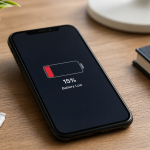
You leave the house with a decent charge, thinking your phone should easily make it through errands, a commute, or a long afternoon out. Then a couple of hours later, the battery has dropped way more than it does at home. You were not even doing anything dramatic. Maybe some maps, a few messages, music, and checking email. Nothing unusual. But somehow the phone is suddenly at 42 percent and getting a little warm in your pocket.
That is the part that gets under your skin. On Wi-Fi, everything feels normal. Outside, on mobile data, the battery starts acting like it has somewhere else to be.
And once you notice it, it is hard to ignore.
Why This Situation Feels So Frustrating
A phone dying faster away from Wi-Fi is not just a small annoyance. It creates this low-level anxiety that sits in the background all day. You want to stay connected, especially when you are moving around, but the more you rely on the phone, the more quickly the battery seems to disappear. That can make even simple plans feel more complicated than they should.
It is also unsettling because the phone has become the thing you count on for everything. Directions, rides, payment apps, work messages, family check-ins. When the battery starts dropping fast, it feels like your safety margin is shrinking with it. You stop using the device freely and start negotiating with it.
Something feels off.
There is also the nagging doubt. Is this normal battery drain because you are on data, or is something actually wrong with the phone? That uncertainty makes the whole thing more irritating. If you knew for sure it was expected, you could at least plan around it.
What People Usually Notice First
Usually it shows up in ordinary moments. You are running errands, your phone is mostly in your pocket, and every time you pull it out the battery is lower than expected. Or you are commuting through areas with uneven signal and watching the percentage tick down even though the screen is off most of the time. You start wondering how much battery you can afford to use before the day is over.
For some people, it hits hardest when they are out all day without a charger. You become oddly careful with your own phone. Maybe you avoid opening apps unless you really need them. Maybe you dim the screen, turn off background stuff, and still feel like the battery is slipping away too fast.
The warming up is another clue people notice early. Not hot, exactly. Just warmer than it should be for no clear reason. That can make the whole thing feel more suspicious, even if the phone is technically still working fine.
It is not completely broken. But it is not right either.
Why It Can Be Confusing
The biggest reason this catches people off guard is that battery life can look perfectly healthy on Wi-Fi. At home or at work, the phone seems stable and predictable. Then the minute you are depending on cellular data, the battery story changes. That difference makes people wonder if mobile data itself is the problem or if the battery is starting to wear out.
It also seems worse on some days than others, which makes it harder to pin down. If you spend one day in strong coverage, the battery might be fine. On another day, the phone may keep searching for a better signal while you travel between neighborhoods, buildings, parking garages, or train stations. That extra effort drains power in a way that is easy to miss because you are not actively doing anything.
A lot of that confusion comes from the fact that the phone is doing work you cannot really see. It is connecting, reconnecting, checking apps in the background, and trying to keep everything updated while you move around. If you want a clearer sense of why this happens on mobile data, it helps to remember that weak or changing signal often matters as much as whatever app you happen to be using.
That is why the problem can feel inconsistent. And annoying.
The Hidden Impact on Daily Use
Battery drain on data affects more than just screen time. It changes how reliable your phone feels during the hours when you actually need it most. At home, with Wi-Fi and a charger nearby, you probably do not think much about battery. When you are out in the world, though, every drop matters more.
That has a real effect on productivity. If you are working remotely, traveling between places, waiting for updates, or trying to stay reachable, a fast-draining battery turns the phone from a tool into a concern. Instead of using it naturally, you start managing it. You delay tasks. You avoid calls. You save maps for later. You hope the battery estimate is being honest.
There is a deeper frustration underneath that too. We depend on constant connection, but that freedom comes with a cost. The more mobile and flexible life gets, the more we lean on a device that is quietly burning through power to keep up. You want the freedom of being reachable anywhere, but not the battery penalty that comes with it.
That tradeoff is real.
When It’s Probably Nothing Serious
In a lot of cases, faster battery drain on mobile data is normal. Not ideal, but normal. If the phone lasts well on Wi-Fi, charges normally, and does not shut down unexpectedly, the battery itself may not be failing. Mobile data simply tends to use more power, especially when signal strength is uneven or the phone keeps switching between towers and network bands.
It can also be more noticeable on long days out because there is no charger nearby to reset the situation. At home, a little extra drain barely registers because you can top up whenever you want. Outside, every percentage point feels more personal.
If the battery drop mostly lines up with travel, weak coverage areas, streaming, navigation, or hotspot use, that points more toward normal behavior than a serious defect.
When You Should Pay More Attention
If the battery is draining extremely fast even in good signal areas, or the phone is getting hot with only light use, that deserves a closer look. The same goes for sudden shutdowns, charging problems, swollen battery signs, or a major drop in overall battery life no matter how you connect.
Another sign is when the battery drains unusually fast while the phone is mostly idle. If it is losing a lot of power just sitting in your pocket, especially after software updates or app changes, there may be something running in the background more aggressively than it should.
You do not need to panic over every bad battery day. But if the pattern becomes constant, it is worth paying attention.
Simple Ways to Improve the Situation
You usually do not need a dramatic fix. Small adjustments often help. Keeping screen brightness under control, limiting heavy background app activity, and updating apps can take some pressure off the battery. So can downloading music, maps, or podcasts before leaving Wi-Fi when you know you will be out for a while.
Signal conditions matter more than people expect, so battery performance may improve simply by moving through areas with stronger coverage or using Wi-Fi whenever it is available. If you notice one app seems to trigger heat or sudden battery drops while on data, that is worth watching too.
A battery bank can also make life easier. Not because it solves the underlying issue, but because it removes some of the stress. Sometimes that alone is enough to make the day feel normal again.
Honestly, peace of mind matters.
Conclusion
If your phone battery drains faster on mobile data than it does on Wi-Fi, you are probably not imagining it. That difference is real, and it can be surprisingly frustrating when you are out all day, commuting, traveling, or just trying to stay reachable. The problem is not always a broken battery. Often it is the hidden cost of staying connected while moving through the world.
Still, that does not make it less annoying. A phone should feel dependable, not like a small source of stress in your pocket. If the drain is mild and mostly tied to weak signal or heavier data use, it is probably just normal behavior. If it is getting worse, causing heat, or happening even when the phone is barely in use, then it is worth looking at more closely.
Either way, the frustration makes sense. You are not asking for anything extreme. You just want to leave the house with a charge and trust that your phone will still be there when you need it later.