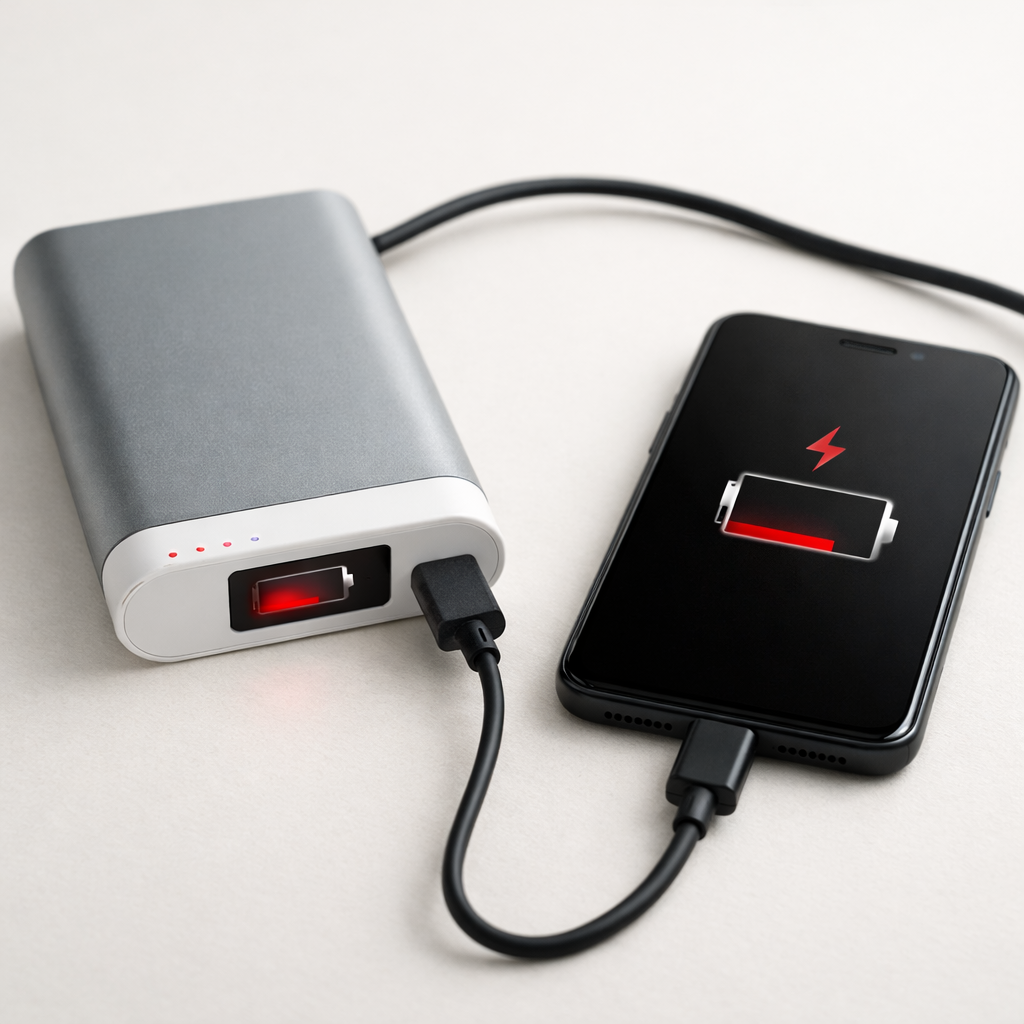
Power Bank Battery Draining Very Fast — Aging Cells or Internal Damage?
Quick Answer
The most common reason a power bank starts draining very fast is a failing battery management circuit (often called the BMS) that can’t keep the internal voltage stable under load. When the voltage sags or “bounces,” the power bank may shut off early, waste energy as heat, or report the wrong battery percentage.
This usually shows up after many charge cycles, exposure to heat, or a hard drop, and it often gets noticeably worse over weeks to a few months. Sometimes it happens suddenly after one incident (a fall, water exposure, or using a mismatched fast charger).
If you need a fast fix
- Use a different cable and charge your phone at a slower rate (avoid fast charging outputs) to reduce voltage stress and see if runtime improves.
- Fully charge the power bank, then do one controlled discharge to about 20% (not to zero) to help the gauge recalibrate and reveal the real capacity.
- Unplug everything, let the power bank cool to room temperature, then charge it from a known-good 5V/2A wall charger for one full cycle.
Quick Diagnosis Table
| Symptom | Most likely cause |
|---|---|
| Drops from 100% to 60% quickly, then slows down | Battery gauge/BMS misreading due to unstable voltage or calibration drift |
| Shuts off when phone hits 20–40% charge or when screen brightness is high | Voltage sag under load from weak cells or BMS over-current protection triggering early |
| Gets warm during light use or while sitting idle | Boost converter inefficiency or internal leakage caused by BMS/board damage |
| Works fine with small devices but fails with fast charge or tablets | BMS can’t regulate voltage at higher current, causing dropouts and early cutoff |
| Charge level indicator jumps up/down or won’t reach 100% | Unstable pack voltage, sensor fault, or worn cell group causing confusing readings |
Why This Happens
A power bank isn’t just a battery in a box. It also has a control board that charges the cells, protects them, and boosts battery voltage up to stable USB power.
When that management circuit starts failing, it can’t “smooth out” normal changes in the battery as your phone pulls power in bursts. The board may see those dips as a low-battery event and shut down early, even if the cells still have usable energy.
In real life, this looks like a power bank that seems to lose 30% in minutes, or one that can’t handle a phone’s fast charging even though it used to. The cause leads to voltage instability, and the symptom is early shutoff, rapid percentage drops, or excessive heat.
Most Common Causes (Ranked)
- 1) Failing battery management circuit (BMS) causing unstable voltage: The protection and regulation board may mis-detect low voltage, over-current, or temperature and cut output too early. This can happen from heat, aging components, or physical shock.
- 2) Cell aging that magnifies voltage sag under load: As lithium cells wear out, their internal resistance rises, so voltage dips more when you draw power. A borderline BMS will react badly to these dips and shut off sooner.
- 3) Boost converter inefficiency or partial failure: The circuit that converts battery voltage to 5V/9V/12V can waste a lot of energy as heat if components degrade. Your devices still charge, but the power bank drains much faster than expected.
- 4) Bad cable, dirty port, or unstable connection: A loose connection can cause rapid connect/disconnect cycles that waste power and confuse the BMS. This is especially common with worn USB-A ports or damaged USB-C connectors.
- 5) “Fast charge” negotiation issues: If the controller can’t properly negotiate PD/QC profiles, it may repeatedly switch modes or fall back unpredictably. That wastes power and can trigger protection cutoffs.
- 6) Internal leakage from moisture or contamination: Even small corrosion on the board can create tiny constant drains or unstable readings, making the power bank lose charge while idle.
If your runtime improves after cooling down, switching to a slower output, or using a different charger, that gradual improvement usually points to regulation or connection issues rather than a fully dead battery.
How to Check the Problem Safely
- Check 1: Test with a known-good cable and a different device. If the drain problem only happens with one cable or one port, the issue may be connection-related, not total capacity.
- Check 2: Try a low-power load first (like earbuds) versus a high-power load (tablet or fast-charge phone). If it fails only on high power, suspect voltage sag and BMS cutoff behavior.
- Check 3: Charge the power bank using a basic 5V/2A wall charger for one full charge. Avoid charging it from a laptop port or a weak adapter during testing.
- Check 4: Observe heat and percentage behavior. Warmth during idle, rapid percentage jumping, or sudden shutoff at “50%” are strong clues of regulation/gauge problems.
- Check 5: If you have a USB power meter, note the output watts and watch for dropouts. If the output repeatedly resets under steady use, the controller is likely unstable.
Safety note: do not open the power bank or puncture the casing, and stop using it immediately if you smell chemicals, see swelling, or feel unusual heat.
How to Fix It
- Fix 1 (easiest): Use the 5V output (no fast charging) and a short, quality cable. Lower current demand reduces voltage dips, which helps an unstable BMS stay on and improves usable capacity.
- Fix 2: Do a gentle recalibration cycle: charge to 100%, rest 30 minutes, discharge to about 20%, then recharge to 100% without interruptions. This can correct a confused fuel gauge that makes the power bank look like it drains faster than it does.
- Fix 3: Clean ports and remove wobble. Gently remove lint with a wooden toothpick (no metal) and try a snug cable; unstable contact can cause repeated restarts that waste energy and trigger protection cutoffs.
- Fix 4: Change how you recharge the power bank: use a reputable wall charger and avoid very hot environments while charging. Overheating stresses the BMS and cells, and a cooler charge often restores more stable behavior.
- Fix 5 (advanced/last resort): If the model is from a reputable brand and still within warranty, request service or replacement. Board-level BMS/boost failures are rarely worth DIY repair because lithium packs are hazardous and parts matching is critical.
Signs of Battery or Hardware Damage
- Bulging case, swelling, or the power bank no longer sits flat
- Strong sweet/solvent-like smell or any hissing sound
- Significant heat during light use, while idle, or during normal charging
- Power bank shuts off instantly when you plug in a device, even at high indicated charge
- Charge level lights/display jumps randomly or shows impossible changes
- Visible corrosion in ports, liquid exposure history, or sticky residue near seams
- It only works when the cable is held at a certain angle (loose internal port or cracked solder)
When Repair Is No Longer Worth It
If the power bank overheats, swells, repeatedly cuts off under modest load, or acts erratically across multiple cables and devices, replacement is usually the safest choice. The internal BMS and boost circuitry are not simple “swap” parts, and lithium packs can fail dangerously when stressed.
As a rule, if the power bank delivers less than about half of its original real-world charges, or if it can’t hold charge for a few days of storage, the value is gone. Put money toward a newer model with better protection, reputable cells, and a warranty rather than paying for uncertain repair.
How to Prevent This Problem in the Future
- Avoid leaving the power bank in hot cars or direct sun, since heat accelerates both cell aging and BMS component failure.
- Recharge with a quality charger and cable, and avoid bargain adapters that can ripple or spike voltage and stress the controller.
- Don’t run it to zero regularly; try to recharge around 20–30% to reduce deep-discharge stress that can destabilize readings.
- Store it around 40–60% charge if you won’t use it for weeks, and top it up every 2–3 months to prevent over-discharge.
- Use fast charging only when you need it; high power creates more heat and more voltage sag, which strains regulation.
- Keep ports clean and avoid yanking cables; physical wear causes intermittent connections that trigger cutoffs and wasted power.
- Buy power banks with clear safety certifications and good thermal design, since better regulation reduces voltage instability over time.
FAQ
Is my power bank “draining fast,” or is the percentage indicator wrong?
It can be either, but jumping percentages and early shutoffs often point to the BMS misreading the battery due to unstable voltage. Try one full charge-rest-discharge-rest cycle and see if the indicator becomes more consistent. If the actual number of phone recharges is still much lower than before, capacity loss or conversion inefficiency is likely real.
Why does the power bank drain faster when I use fast charging?
Fast charging pulls higher power, which creates more heat and bigger voltage dips inside the power bank. A weak cell pack or unstable BMS may interpret those dips as low battery and cut off early. Using the 5V standard output often improves runtime and stability.
Can a power bank lose charge while it’s not being used?
Yes, some self-discharge is normal, but noticeable loss over a day or two suggests internal leakage or a controller that won’t fully sleep. Moisture damage, failing components, or a stuck boost circuit can drain it even with nothing plugged in. If it also feels warm while idle, stop using it and replace it.
If the issue keeps coming back, it’s usually worth looking at broader battery behavior rather than a single fix. That’s the approach Mark Reynolds follows in the complete battery guide.
For a full overview of this issue and step-by-step solutions, read the complete troubleshooting guide.