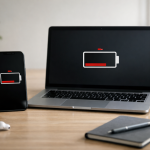
Laptop Battery Draining While Lid Closed — Sleep Mode Failure Causes
Quick Answer
If your laptop battery drains while the lid is closed, the most likely cause is that the device is not fully entering sleep and is keeping some power circuits active. Instead of “resting,” it may be waking in the background for updates, network activity, or a driver issue, which uses far more power than true sleep.
In normal sleep, a healthy laptop might lose a few percent overnight. If you’re losing 10–30% (or more) over several hours with the lid closed, it usually means sleep is failing, “modern standby” is staying too active, or the laptop is repeatedly waking itself.
If you need a fast fix
- Do a full shutdown instead of sleep: Use Shut down from the power menu before putting it in a bag to stop background wake-ups completely.
- Disable wake sources quickly: Turn on Airplane mode, unplug USB devices, and disconnect docks before closing the lid to reduce wake triggers.
- Use hibernate for travel: Choose Hibernate (or enable it) so the system saves state to disk and powers off most circuits.
Quick Diagnosis Table
| Symptom | Most likely cause |
|---|---|
| Battery drops 15–40% overnight with lid closed | Sleep state not reached or modern standby staying active due to settings, network, or firmware |
| Laptop is warm in a bag after closing the lid | It woke repeatedly or never slept; background tasks kept CPU/GPU active |
| Fans run briefly after lid close, or lights keep blinking | Driver power-management problem (graphics, Wi‑Fi, storage) preventing deep sleep |
| Battery drain started after an update | New BIOS/firmware, Windows/macOS update, or driver change affecting sleep behavior |
| Drain happens mainly when connected to Wi‑Fi | Network wake, “wake on LAN,” or “keep network connected during sleep” behavior |
Why This Happens
When you close the lid, your laptop should enter a low-power sleep state where most hardware powers down. If sleep fails, parts of the system stay on, such as the CPU, Wi‑Fi, storage controller, or a connected USB device.
Real-world examples are common: a laptop downloads updates while “asleep,” a USB mouse wakes the system in a backpack, or a Wi‑Fi driver keeps the network active to maintain connections. Any of these can keep power circuits running and slowly drain the battery.
The result is simple: the laptop behaves like it is partially awake, so it uses power like it is partially working, which shows up as noticeable battery loss (and sometimes heat) while the lid is closed.
Most Common Causes (Ranked)
- 1) Modern standby or sleep mode not actually going idle: On many newer laptops, “sleep” is a connected standby that can keep networking and background tasks active, especially if settings allow it.
- 2) Wake timers and scheduled maintenance: The system can wake itself to install updates, run antivirus scans, index files, or perform maintenance, then fail to return to deep sleep.
- 3) Driver or firmware power-management bug: Wi‑Fi, Bluetooth, graphics, storage, and chipset drivers can block low-power states or cause repeated wake events after lid close.
- 4) USB devices, docks, or external monitors keeping the system active: A dock, receiver dongle, or USB storage can prevent sleep or trigger wake-ups due to power or activity changes.
- 5) Network wake features: Settings like wake-on-LAN, “allow this device to wake the computer,” or “keep network connected during sleep” can cause frequent wake events.
- 6) Battery wear masking a sleep issue: An older battery may drop faster than expected, making normal sleep loss look severe, even if the laptop is mostly sleeping.
If your drain improves gradually after changing one setting at a time, that usually indicates you’re removing a specific wake trigger or driver behavior rather than dealing with a failing battery.
How to Check the Problem Safely
- Check 1: Close the lid for 60–90 minutes, then feel the laptop’s underside (carefully). If it’s noticeably warm, it likely stayed active or woke up repeatedly.
- Check 2: Test with everything unplugged. Remove USB devices, SD cards, dongles, external monitors, and docks, then try sleep again to see if drain changes.
- Check 3: Test with Airplane mode on. Enable Airplane mode before closing the lid; if drain drops sharply, networking or wake features are involved.
- Check 4: Compare Sleep vs Hibernate vs Shut down. Measure battery percentage after the same time period to identify whether the issue is sleep-specific.
- Check 5: Check your recent changes. If this started after an OS update, driver update, or BIOS update, note the date so you can roll back or update again properly.
Safety note: avoid leaving a warm laptop in a sealed bag, on bedding, or on a soft surface, since a sleep failure can create heat buildup.
How to Fix It
- Fix 1 (easiest): Use Hibernate or Shut down for transport. This prevents background wake-ups because the laptop powers down most circuits, reducing drain and heat risk.
- Fix 2: Adjust lid and sleep settings. Set “When I close the lid” to Sleep or Hibernate (not “Do nothing”), and reduce or disable background activity during sleep in power settings so the system stays inactive.
- Fix 3: Stop wake triggers from devices. Disable “Allow this device to wake the computer” for the mouse/keyboard/network adapter, and unplug docks and USB receivers when sleeping to remove common wake sources.
- Fix 4: Update or reinstall drivers that control sleep. Update chipset, graphics, Wi‑Fi, Bluetooth, and storage drivers from the laptop maker, and install BIOS/firmware updates that mention power, standby, or thermal fixes.
- Fix 5 (advanced/last resort): Switch sleep behavior or repair system power settings. On some systems you can disable connected/modern standby (if supported) or perform an OS repair/reset; this helps if a corrupted power profile or system component breaks sleep transitions.
Signs of Battery or Hardware Damage
- Battery percentage drops rapidly even after a full shutdown (not just sleep).
- Laptop shuts off suddenly at 20–40% battery or the percentage jumps around.
- Battery won’t charge past a certain point or charging is inconsistent with the same charger.
- Battery reports “service recommended,” “replace now,” or very low health in the system battery status.
- Noticeable swelling of the bottom case, trackpad, or palm rest, or the laptop no longer sits flat.
- Strong chemical smell, hissing, or excessive heat near the battery area.
- Charging port or power adapter gets unusually hot or works only at certain angles.
When Repair Is No Longer Worth It
If the laptop only drains during sleep and works normally otherwise, it’s usually worth fixing with settings and driver/firmware updates. If you also have shutdown drain, sudden power loss, swelling, or charging instability, the battery or power circuitry may be failing and repair becomes more urgent.
As a rule, replace the battery if it restores most of the laptop’s value at a reasonable cost. If the battery is expensive, unavailable, or the machine also needs major work (motherboard, charging port, multiple components), replacement of the laptop may be the better long-term option.
How to Prevent This Problem in the Future
- Use Hibernate or Shut down when putting the laptop in a bag or leaving it overnight.
- Keep BIOS/firmware and key drivers (chipset, Wi‑Fi, graphics) updated from the laptop manufacturer.
- Unplug docks and USB receivers before sleep, especially wireless mouse dongles and external drives.
- Disable unnecessary wake features like wake-on-LAN if you don’t need remote wake.
- Turn off network connectivity during sleep if your laptop supports it and you don’t need connected standby.
- After major OS updates, re-check power settings, lid-close behavior, and sleep timers.
- Periodically check battery health so you can tell the difference between sleep drain and normal battery aging.
FAQ
Why does my laptop still drain battery in sleep mode?
Sleep is not always a fully “off” state. If the laptop uses a connected standby mode or is being woken by timers, devices, or network activity, it can keep power circuits active and drain the battery. Large overnight drops usually mean it isn’t staying in a low-power state consistently.
Is it normal for a laptop to get warm while the lid is closed?
A slight warmth can happen briefly as it transitions into sleep, but it should not stay warm for long. Ongoing warmth suggests it is partially awake, doing background work, or repeatedly waking. For safety, avoid storing it in a tight bag until you’re sure it sleeps correctly.
Should I use hibernate instead of sleep to stop battery drain?
Yes, hibernate is often the best compromise between convenience and battery savings. It saves your session and powers down much more than sleep, so it’s far less likely to drain significantly. If sleep is unreliable on your model, hibernate or shutdown is the most dependable solution.
For a full overview of this issue and step-by-step solutions, read the complete troubleshooting guide.
Understanding how batteries behave over time can make troubleshooting much easier. Mark Reynolds breaks these patterns down in simple terms. You can explore more in the full guide.