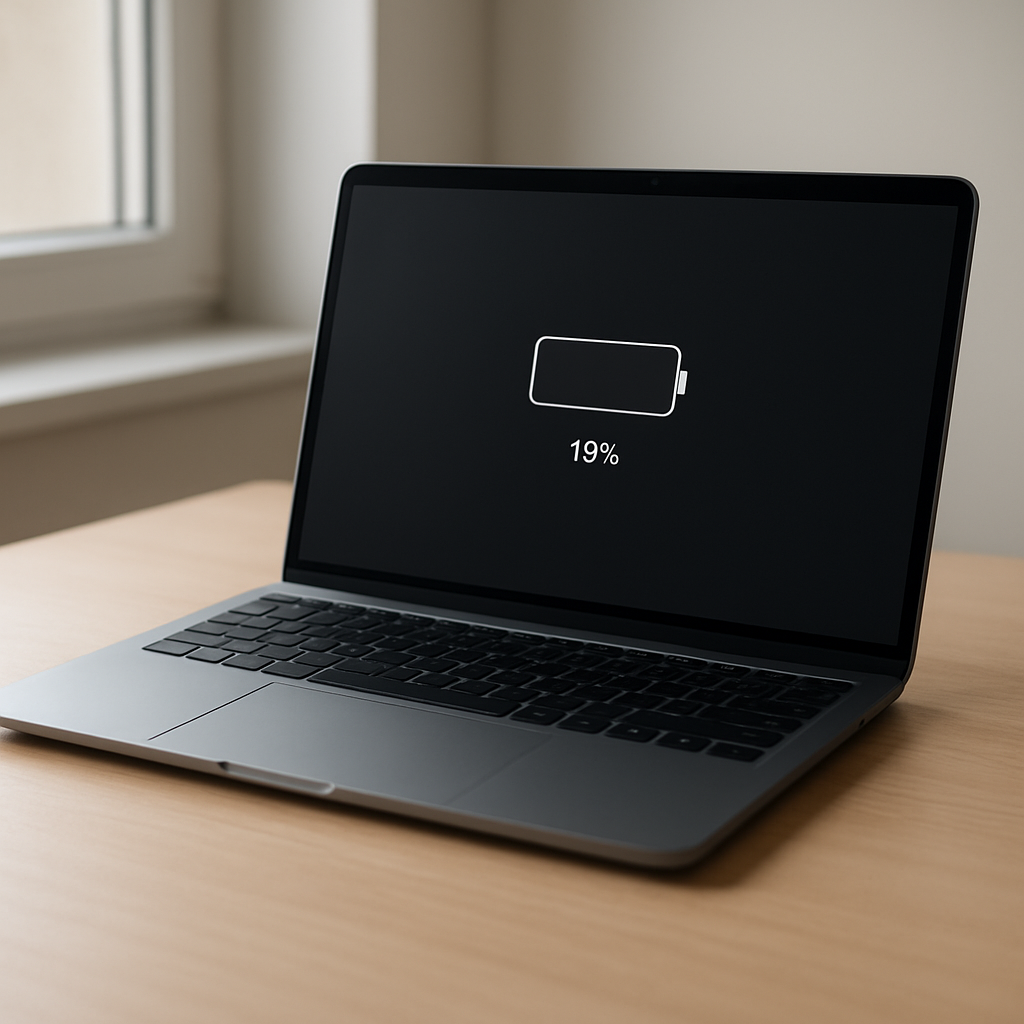
Laptop Charging Extremely Slowly — Power Limit or Hardware Restriction?
Quick Answer
Most “extremely slow charging” problems happen because your laptop is using as much power (or more) than the charger can supply. When that happens, the battery only gains a little charge, stays stuck at one percent, or even drops while plugged in.
This usually means the adapter wattage is too low for what you’re doing, the laptop is limiting input (common with non-matching USB-C chargers), or charging is slowed on purpose to protect the battery. A normal full charge is often 1.5–3.5 hours on many laptops, but it can stretch to 6+ hours if the charger is underpowered or the system is under heavy load.
If you need a fast fix
- Shut down the laptop (or fully sleep/hibernate it), then charge for 20–30 minutes to see if the percentage climbs faster.
- Use the original charger and cable (or a known-good USB-C PD charger with equal or higher wattage) and plug directly into a wall outlet.
- Disconnect high-power accessories (external drives, docks, extra monitors) and lower screen brightness while charging.
Quick Diagnosis Table
| Symptom | Most likely cause |
|---|---|
| Battery percentage stays flat or drops while plugged in during gaming or video editing | System power draw exceeds the charger’s wattage, so the battery is supplementing power |
| “Plugged in, not charging” or “Slow charger” warning appears | Charger/cable/port can’t negotiate enough wattage (USB-C PD mismatch, weak cable, wrong port) |
| Charges normally when laptop is off, but very slowly when in use | Background load is high (CPU/GPU usage, high performance mode), leaving little power for charging |
| Charging is fast up to 60–80% then becomes very slow | Normal charge taper or a battery-care limit/optimized charging feature reducing charge speed |
| Only charges when the cable is held at an angle or after re-plugging | Loose/damaged DC jack or USB-C port, worn cable, or contaminated connector causing low input |
Why This Happens
Your laptop is like a bucket with two drains: one to run the computer (CPU, GPU, screen, fans, accessories) and one to fill the battery. The charger is the faucet. If the faucet flow is small and the drains are wide open, the battery fills painfully slowly or not at all.
This is especially common when using a lower-wattage replacement charger, a phone-style USB-C charger, or a dock that can’t deliver full power. It also happens when the laptop boosts performance (like during games or heavy work), because power use jumps quickly.
In practice, the symptom you see is simple: the laptop is “charging,” but the available power after running the system is so low that the battery gains only a few percent per hour.
Most Common Causes (Ranked)
- 1) Underpowered charger (wrong wattage): If your laptop expects a 65W/90W/135W adapter and you use a 45W (or less), charging will crawl, especially while the laptop is on.
- 2) USB-C power negotiation limits (charger, cable, or port): Many laptops need USB-C Power Delivery at specific profiles (like 20V). A cable that can’t handle higher current or a non-PD charger can force low wattage.
- 3) System load is too high while charging: High brightness, performance mode, heavy apps, or a busy background process can consume most of the adapter’s output so the battery barely charges.
- 4) Battery protection features slowing charging: “Optimized charging,” “Battery health mode,” or charge limits (often set to 60–80%) can make charging appear slow or stop early by design.
- 5) Power is being split to accessories or a dock: Charging through a dock, hub, or monitor USB-C can reduce what reaches the laptop, especially if the dock also powers drives and displays.
- 6) Connector/port resistance or damage: A worn DC jack, loose USB-C port, or debris can cause voltage drop and force the system to limit charging for safety.
If charging slowly becomes steadily faster after you reduce usage or switch to the correct charger, that usually indicates the battery is fine and the bottleneck was power input, not battery failure.
How to Check the Problem Safely
- Check 1: Look at the charger label and find its wattage (W). Compare it to what your laptop model requires or what the original charger provided.
- Check 2: Try charging with the laptop shut down for 20–30 minutes. If the percentage rises noticeably faster, your charger is likely being overwhelmed by system use.
- Check 3: If using USB-C, make sure you’re on the correct charging port (some USB-C ports are data-only). Try a different USB-C port if your laptop has more than one.
- Check 4: Remove extra load: unplug external drives, disable keyboard backlight, lower brightness, and close heavy apps. Then observe if the “time to full” estimate improves.
- Check 5: Inspect the cable ends and port for dust or looseness. Re-seat the connector firmly and see if the charger warning disappears.
Safety note: avoid using damaged cables, hot-to-the-touch chargers, or loose connectors that spark or crackle, and don’t attempt internal battery or port repairs unless you’re qualified.
How to Fix It
- Fix 1 (easiest): Use the original charger and cable directly from a wall outlet. This restores the expected wattage and removes power loss from hubs or extension equipment.
- Fix 2: Match or exceed the required wattage with a quality replacement. If your laptop came with 65W, use 65W or higher from a reputable brand so the system has enough headroom to run and charge.
- Fix 3: For USB-C charging, use a proper USB-C PD charger and an e-marked cable rated for the needed power. A weak cable can silently cap charging to a much lower level even if the charger is strong.
- Fix 4: Reduce power use while charging by switching to a balanced/battery saver mode, lowering brightness, and pausing demanding tasks. This frees more of the adapter’s output for the battery.
- Fix 5 (advanced/last resort): Update BIOS/UEFI and chipset/power management drivers, then check vendor battery settings (charge limit, optimized charging). Firmware bugs or a strict charge limit can mimic a slow-charge issue.
Signs of Battery or Hardware Damage
- Battery percentage jumps up or down unpredictably (for example, 40% to 15% in minutes).
- Laptop shuts down suddenly at moderate charge levels (like 20–40%).
- Battery or bottom case swelling, bulging, or the trackpad area lifting.
- Charger plug or USB-C connector gets unusually hot, or you smell burning plastic.
- Charging only works when the cable is held in a specific position, suggesting a worn port/jack.
- Battery health reports show very low capacity compared to design capacity, or the system reports “service recommended.”
- Charging repeatedly starts and stops every few seconds with no movement, even with a known-good charger.
When Repair Is No Longer Worth It
If the laptop needs a battery plus a charging port repair (or motherboard-level power components), the combined cost can approach the value of an older machine. In that case, slow charging may be the least visible symptom of a broader power problem.
As a rule, battery replacement is usually worth it if the laptop is otherwise reliable and the part is reasonably priced. If repair estimates exceed roughly 30–50% of the cost of a comparable replacement laptop, put that money toward a newer model with a fresh battery and warranty.
How to Prevent This Problem in the Future
- Use a charger that meets your laptop’s required wattage, especially for gaming/workstation models.
- If you rely on USB-C, buy a reputable USB-C PD charger and a high-wattage (e-marked) cable to avoid silent power caps.
- Avoid charging through low-power hubs, front-panel ports, or weak docks when you need full speed.
- Reduce heavy workloads while charging on a low-watt adapter, or charge while the laptop is asleep/off.
- Keep ports clean and avoid yanking the cable; connector wear increases resistance and reduces effective charging power.
- Enable battery health features thoughtfully: a charge limit can extend battery life, but it can also look like “slow charging” if you forget it’s on.
- Don’t use off-brand chargers that run hot or lack proper protections; unstable output can trigger system throttling.
FAQ
Why does my laptop charge faster when it’s turned off?
When the laptop is off, almost all incoming power can go to the battery. When it’s on, the charger must run the screen, CPU/GPU, fans, and accessories first, leaving less power for charging. This strongly suggests the charger wattage is limited compared to your current usage.
Can a USB-C phone charger cause extremely slow laptop charging?
Yes. Many phone chargers don’t support the USB-C Power Delivery profiles a laptop needs, or they top out at low wattage like 18W–30W. Your laptop may still show “charging,” but it will be very slow or may not increase under load.
Is it normal for charging to slow down near 80–100%?
Yes, charging typically tapers as the battery gets closer to full to reduce heat and stress. Some laptops also enable “optimized charging” or a charge limit, which can slow or pause charging intentionally. If it’s only slow near the top and otherwise normal, it’s usually not a fault.
For a full overview of this issue and step-by-step solutions, read the complete troubleshooting guide.
Most battery issues are easier to understand once you break them down step by step. That’s the approach Mark Reynolds takes across all troubleshooting guides. For more details, visit the complete guide.