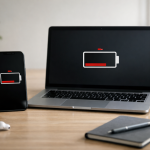
Device Battery Draining When Idle (Screen Off): Causes, Tests, and Fixes
Quick Answer
If your battery drops noticeably while your device is idle, the device is usually not reaching a true low-power state or it is being woken up repeatedly by apps, syncing, notifications, wireless radios (Wi-Fi/cellular/Bluetooth), or system tasks (updates/indexing). The fastest way to fix it is to: identify what’s using battery with the screen off, reduce background activity and syncing, stabilize network conditions, and ensure the device can enter deep sleep/standby. If idle drain stays high even after these steps, battery health or a hardware/firmware issue may be involved.
1) What “idle drain” really means
“Idle” rarely means “doing nothing.” Even with the screen off, devices may keep working in short bursts: checking email, maintaining network connections, updating apps, backing up photos, or running background services. Your battery drains when:
- The device wakes up too often (notifications, syncing, apps)
- Radios stay active (weak Wi-Fi/cellular signal, Bluetooth accessories)
- The device never reaches deep sleep (standby/sleep misconfiguration, OS bug, driver issue)
- The battery is aged and loses charge faster even with low activity
2) What’s normal idle drain?
These ranges are useful benchmarks:
- Phones/Tablets: ~1–4% over 8 hours (good), 5–10% (needs tuning), 10%+ (usually abnormal)
- Laptops: ~1–5% over 8 hours (good), 6–12% (borderline), 12%+ (often a standby/sleep issue)
Heat check: if the device feels warm while “idle,” that almost always means background activity or wake-ups—not “normal battery behavior.”
3) Fast diagnostic: one controlled test (30–60 minutes)
Do this once to avoid guessing:
- Charge to a known level (e.g., 80% or 100%).
- Close heavy apps (video, games, social, cloud sync, VPN).
- Leave the device untouched for 45–60 minutes (screen off).
- Check battery drop and whether the device feels warm.
Interpretation:
- Big drop + warm → app/system is running in background
- Big drop only in low signal areas → network/radio drain
- Mostly overnight drain → wake-ups, sync, standby/sleep not deep enough
4) Quick diagnostic table (symptom → likely cause → best first fix)
| Symptom | Most likely cause | Best first fix |
|---|---|---|
| Device gets warm while idle | Background apps / sync loop / OS task | Check screen-off battery usage; restart; update apps |
| Idle drain worse on mobile data | Cell modem activity, weak signal, 5G switching | Test LTE-only; use Wi-Fi; restrict background data |
| Drain spikes overnight | Notifications + background refresh | Limit background refresh; reduce push notifications |
| Laptop drains with lid closed | Modern Standby / wake timers / driver | Disable wake timers; update chipset/Wi-Fi; test hibernate |
| Drain improved in Airplane Mode | Radio/network-related drain | Fix signal conditions; disable scanning; reduce sync |
5) Step-by-step fixes (high impact, safe)
Step 1 — Check “screen off” battery usage
Your device usually shows what consumes power in the background. Look for apps using battery when the screen is off, or a “System” component consuming unusually high power.
- Android: Settings → Battery → Battery usage (check “Background”)
- iPhone/iPad: Settings → Battery (look for “Background Activity”)
- Windows: Settings → System → Power & battery → Battery usage
- macOS: Battery/Energy view (background activity / energy impact)
Action: if one app dominates background usage, restrict it (background refresh), force close, update, or uninstall to test.
Step 2 — Reduce background activity (biggest win)
- Disable background refresh for non-essential apps (social, shopping, news, games)
- Reduce auto-sync frequency for email/cloud if you don’t need instant updates
- Turn off always-on features you don’t use (always-on display, constant location)
Step 3 — Fix network/radio drain
Wireless radios are a top idle drain cause, especially with weak or unstable signal.
- Test one idle period with Airplane Mode (best diagnostic)
- If drain improves, focus on signal and background data/sync
- Disable unnecessary scanning features (Wi-Fi/Bluetooth scanning on Android)
- If 5G is unstable, test LTE-only for a day
Step 4 — Reduce wake-ups from notifications
Many “small” wake-ups add up. Consider:
- Disable non-essential push notifications
- Use scheduled summaries / quiet hours
- Turn off vibration for low-priority apps
Step 5 — Restart once (simple but effective)
A restart clears stuck processes and resets power states. If idle drain started “suddenly,” rebooting fixes a surprising number of cases.
Step 6 — Update OS + apps (especially after major updates)
Post-update battery drain is common while the system re-optimizes apps and re-indexes data. Keeping apps updated often resolves “background loop” issues.
6) Laptop-specific: idle drain when the lid is closed
If a laptop loses a lot of battery with the lid closed, it may not be entering deep sleep.
- Disable wake timers
- Prevent network adapter from waking the computer
- Update chipset + Wi-Fi drivers
- Test Hibernate overnight (if Hibernate fixes it, sleep/standby is the issue)
7) When to suspect battery aging (instead of settings)
Battery aging is more likely when:
- Overall runtime is poor even with light active use
- Battery % drops suddenly (e.g., 40% → 20%)
- Unexpected shutdowns happen at moderate percentages
- The battery is old (often 2+ years of heavy daily use for phones; 3–5 years for laptops)
Battery wear usually affects all usage, not only idle. If the problem is mainly idle drain, start with wake-ups, radios, and background services first.
8) Safety notes
- If your device is hot while idle, avoid charging it until you identify the cause.
- If you notice swelling, unusual smell, or physical deformation, stop using the device and seek service immediately.
FAQ
Is it normal for a device to lose battery overnight?
Yes—some drain is normal because devices run background tasks and maintain network connections. The goal is low drain, not zero. :contentReference[oaicite:1]{index=1}
How much idle drain is acceptable?
A few percent over several hours is common. Rapid drops, heat while idle, or double-digit overnight loss usually means excessive wake-ups or a standby/sleep issue. :contentReference[oaicite:2]{index=2}
Does turning the device off completely stop battery drain?
Powering off reduces drain dramatically, but batteries can still self-discharge very slowly over long periods. :contentReference[oaicite:3]{index=3}
Conclusion
Idle battery drain is usually caused by background activity, network/radio behavior, or a device not reaching deep sleep—rather than a “mystery battery problem.” Start with a controlled test, check screen-off battery usage, reduce background activity and wake-ups, stabilize network conditions, and keep OS/apps updated. If drain remains severe after these steps, consider battery health or a deeper power-management issue.
Related Posts
- Battery Draining in Sleep Mode
- Phone Battery Drains Faster on Mobile Data
- Battery Drains Faster After Update
- Laptop Battery Drains When Closed
For a full overview of this issue and step-by-step solutions, read the complete troubleshooting guide.